01 — The Operator's Problem
Your company is already using AI.
The question is whether anyone is actually managing it.
Tools spread department by department. Output went up. So did the exposure. WinAt.ai gives owners and senior leaders of 15–500 employee companies a clear read on the three things that decide whether AI becomes leverage or liability.
12 Questions · Under 5 Minutes · Visibility · Accountability · Capability

02 — Recognition
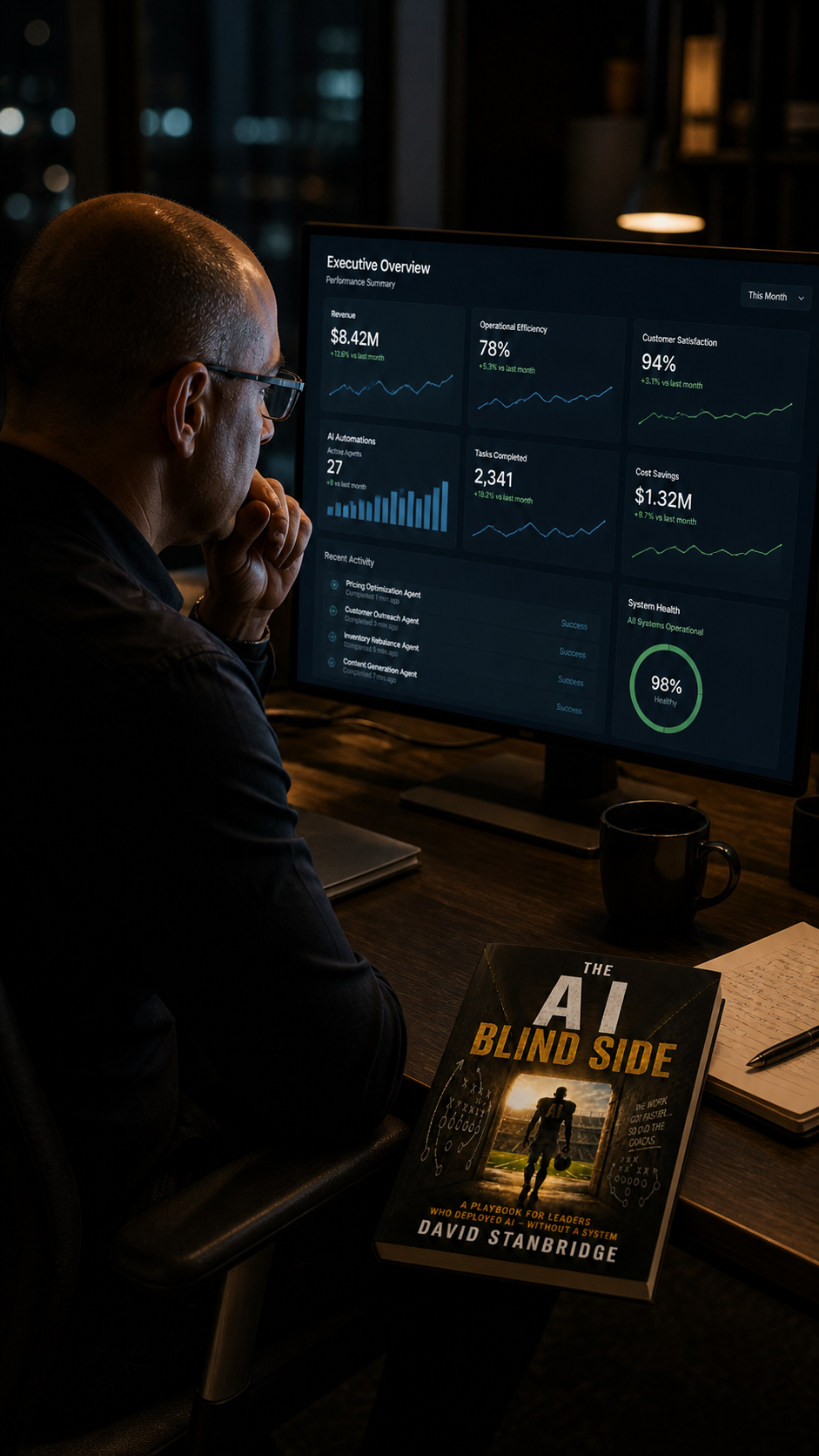
The dashboard says things are moving. It does not tell you whether the system is holding.
AI is making output faster across every department. The numbers go up. The charts trend the right way. What the dashboard cannot show you is whether anyone is watching the seams, visibility into where the tools live, accountability when the work is wrong, capability to tell signal from speed.
If you are reading the metrics and still feel something is off underneath them, that instinct is the point.
03 — Recognition
You're not alone. Most companies are experiencing the same gap.
Tools spread. Output increases. Dashboards look better. But the operating system underneath AI, the visibility, accountability, and capability that make it safe, is still missing.
01
Do you know every place AI is being used in your company right now?
02
Is anyone accountable when an AI-assisted output goes wrong?
03
Can your team tell the difference between AI doing the work and AI hiding it?
If your answer to any of those is "I'm not sure," that is the blind side.
04 — The Blind Side
What your dashboard shows. And what it doesn't.
Faster output and lower friction are visible. The real exposure forms underneath: accountability gaps, data exposure, brand dilution, skill atrophy, hidden costs, governance debt, and autonomous AI risk.
70%
of AI success comes from people, processes, and organizational capability, not the tool itself.
BCG: 10/20/70 Framework
56%
of CEOs say they have seen no financial benefit from AI investment so far.
PwC Global CEO Survey
77%
of employees using AI say it has increased their workload, not reduced it.
Upwork Research Institute, 2025
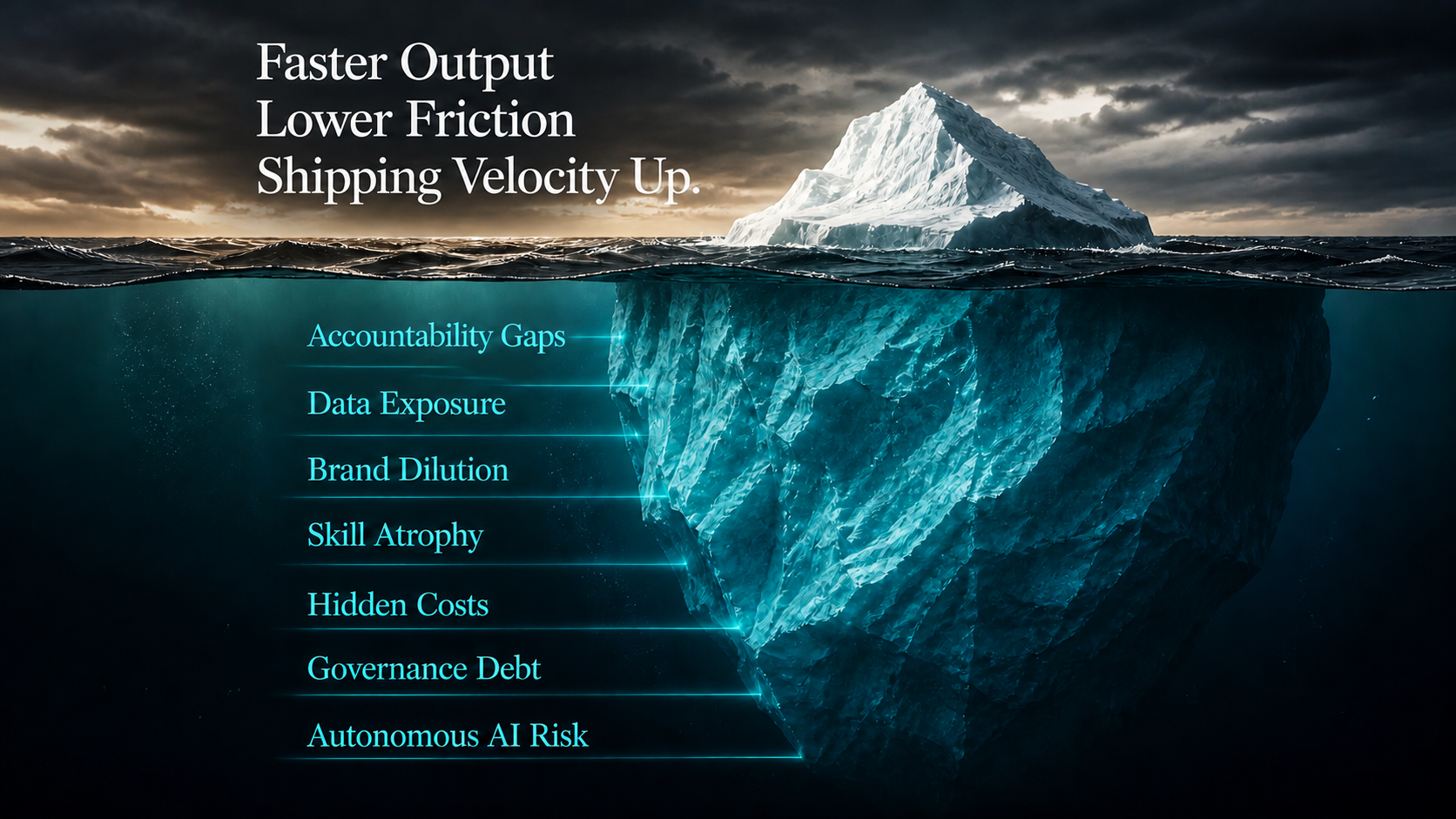
Seven categories of exposure hiding under measurable output gains.
A Word of Caution
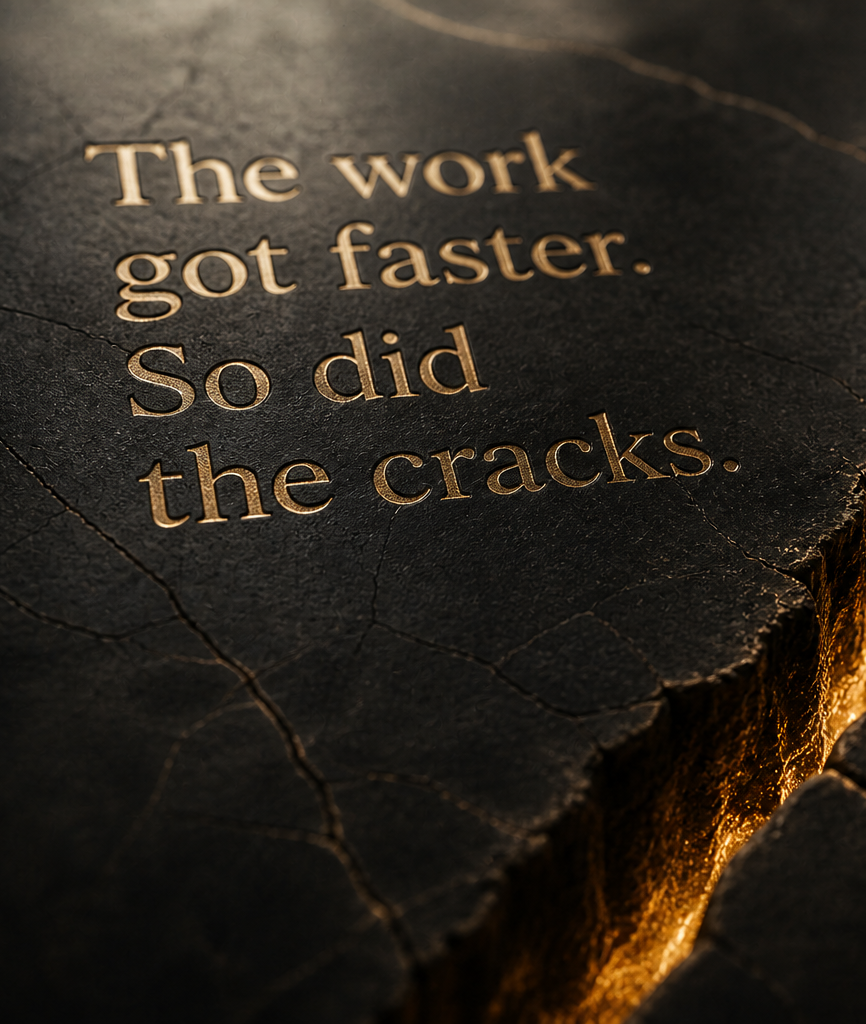
Speed is not the problem. Ungoverned speed is.
05 — The Three Pillars
There are only three things a leader needs to control for AI to work.
01
Visibility
Know every place AI is being used in your business, sanctioned, shadow, and somewhere in between. You cannot govern what you cannot see.
02
Accountability
Name the human who owns each AI-touched workflow. When the output is wrong, the answer to "who decides" is a person, not a tool.
03
Capability
Build the judgment, training, and review muscles your team needs to use AI as leverage instead of a shortcut that hides the cracks.
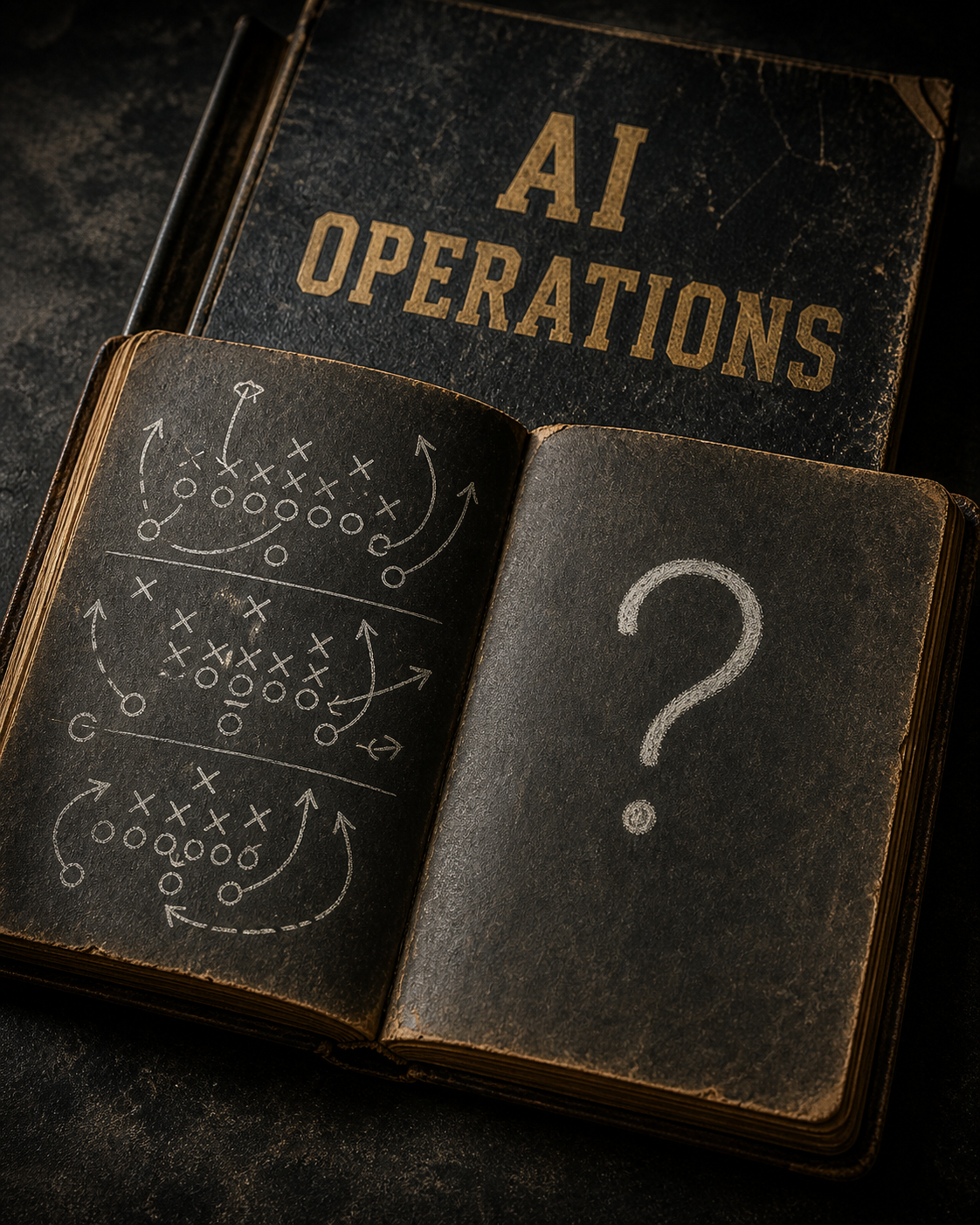
06 — How this works
From unmanaged adoption to governed advantage.
A clear sequence that takes a leadership team from "we have AI everywhere and no system" to "we know what's running, who owns it, and how to scale it with confidence."
01
Assess
Map the AI already running inside your business. Tools, workflows, data flow, and gaps across visibility, accountability, and capability.
02
Build
Install the standards, ownership, and review rhythms that turn AI use into something your business can manage and measure.
03
Enable
Build practical AI capability across teams. Prompting, context, role-based workflows, custom GPTs, and repeatable skills that fit the actual work.
04
Scale
Expand what's working with confidence. Measure outputs, refine standards, and compound the advantage as the technology evolves.
07 — Built on Experience
Built on a career of seeing what breaks before it breaks.
David Stanbridge has spent two decades inside the seams of growing companies, the place where the org chart stops describing how the work actually happens. The AI Blind Side is the playbook he wrote for leaders who deployed AI without a system and need to catch up before the cracks show.
12 questions · under 5 minutes
08 — The Next Move
Find your AI Blind Side Score.
A 12-question diagnostic that takes under five minutes. Identifies the gaps across visibility, accountability, and capability, and tells you which one to close first.

AI governance for owners and senior leaders of mid-market companies.
Navigate
CONTACT
© 2026 WinAt.ai · David Stanbridge · Privacy Policy · Disclaimer
The AI Blind Side · A playbook for leaders who deployed AI without a system.