For owners paying for AI and not seeing the return
The AI works. The return doesn't. Three things are missing.
Clear rules. Capable people. Repeatable work.
Your team is already using AI. The tools are fine. What's missing is the structure around them. WinAt.ai helps owners who are already paying for AI put clear rules, trained people and repeatable workflows in place.
Get your free AI Blind Side ScoreTalk it through with Dave
Free Score: 12 questions, 5 minutes. Free call: 30 minutes, plain answers.
What you see is the win. What you don't see is the risk.
Faster output is easy to see. Accountability gaps, data exposure and hidden costs sit below the surface.
Clear rules, training and workflows help you see the whole picture.

AI isn't the advantage. The business system around it is.
The tools aren't what separates them. Anyone can buy the same software this afternoon. What sets the 6% apart is the structure around it: clear rules for where AI fits, people trained to use it well, and skills and workflows built into how the day gets done.
Boston Consulting Group sees the same split. The companies getting real value from AI put about 70% of their effort into people and processes, 20% into technology and data, and only 10% into the algorithms themselves.
You don't have to slow down. You need the structure that makes speed safe.
Sources: McKinsey, The State of AI 2025. Boston Consulting Group, the 10-20-70 rule for AI efforts.
The three things that get results
Strategy and Governance
Direction and guardrails
Nobody has told your people where the line is.
78% of employees who use AI at work say they use tools their employer hasn't approved.
WalkMe (SAP) AI in the Workplace Survey, 2025
Most owners can't say which AI tools their people use or what company data goes into them. Governance puts clear lines in place: where AI fits, what is off limits, who decides, and who answers for the results.
- Which tools, accounts and agents are in use
- Where company and client data is going
- Who checks AI work before it leaves
Training
Use AI the right way
Most people picked up AI on their own and stopped at a few tricks.
7.5% of employees who use AI at work have had extensive training.
WalkMe (SAP) AI in the Workplace Survey, 2025
Practical training on how AI works, what to tell it, which tools to use and how to check what comes back. It starts from your team's real work, so the habits carry over to Monday.
- Understand how AI thinks, so you know when to trust it and when not to
- Give it the context, examples and standards that get work you can use
- Spot weak, unsupported or off-brand output before it leaves the business
Skills, workflows and agentic operations
Make AI work like your best people
Most people use AI like a novice intern: new instructions every time, uneven results.
56% of CEOs say AI has delivered no significant financial benefit to date.
PwC 29th Global CEO Survey, 2026 (4,454 CEOs)
A trained AI works like a seasoned veteran. It knows who you are, how you sound and how your business runs. Skills teach it each task. Workflows chain those tasks together so the whole job speeds up.
- A company brain: who you are and how you sound
- Skills: saved instructions for each task
- Workflows that chain tasks, then agents for the routine ones
Could you answer these today?
Question 1
What AI tools are your people actually using, not just the ones you approved?
Question 2
If AI-assisted work reached a customer with a serious error, who was responsible for catching it?
Question 3
How much time is AI really saving after review, correction and rework?
If any of these took you more than a moment, you are not alone. Most owners find that AI spread through the company one person at a time, so the answers were never written down. The free score shows where the gaps are, and it is a practical place to start.
Get your free AI Blind Side Score
Faster output is not automatically faster work. See how Net Speed works →

The book
The book shows the gaps. WinAt.ai helps you close them.
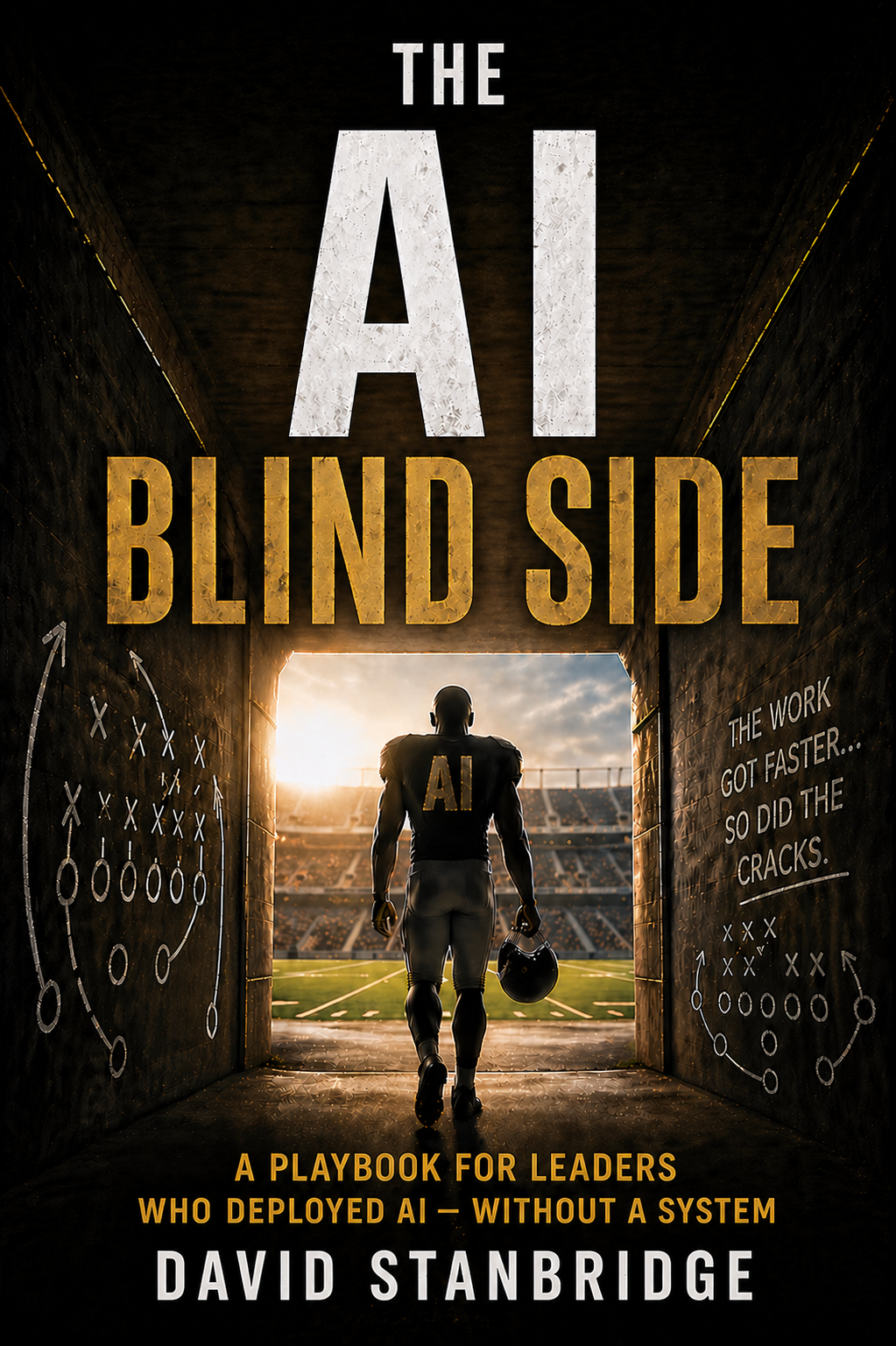
The work got faster. So did the cracks.
The AI Blind Side is a playbook for leaders who deployed AI without a system: what owners miss when AI spreads through a company one person at a time, and how to start getting the return.
What it feels like from the owner's chair
"We're faster - but I don't feel like we're actually better."
"I don't know what AI is saving us versus what it's quietly costing us."
"We're using AI everywhere - but I don't think anyone really owns it."
"Something feels off and I can't point to exactly what it is."
Most leaders feel it before they can name it. This score names it.
Take the free 12-question AI Blind Side Score. About 5 minutes.
See where your company stands. Then, if you want, talk it through with Dave: free 30 minutes, plain answers, whether you hire WinAt.ai or not.

AI governance for owners who are paying for AI and not seeing the return.
Navigate
CONTACT
© 2026 WinAt.ai · Absolute Success LLC · Privacy Policy · Disclaimer
The AI Blind Side · A playbook for leaders who deployed AI without a system.