
This post answers: Why most companies are getting incremental returns on significant AI investment, where the real determinant of AI success actually lives, and what to do about it without spending another quarter debating tools.
Almost every AI strategy conversation starts the same way. Which tool. Which model. Which platform. Which version. The assumption underneath is that the technology choice is the strategic choice, and once you get that right, the rest follows.
The research says the opposite.
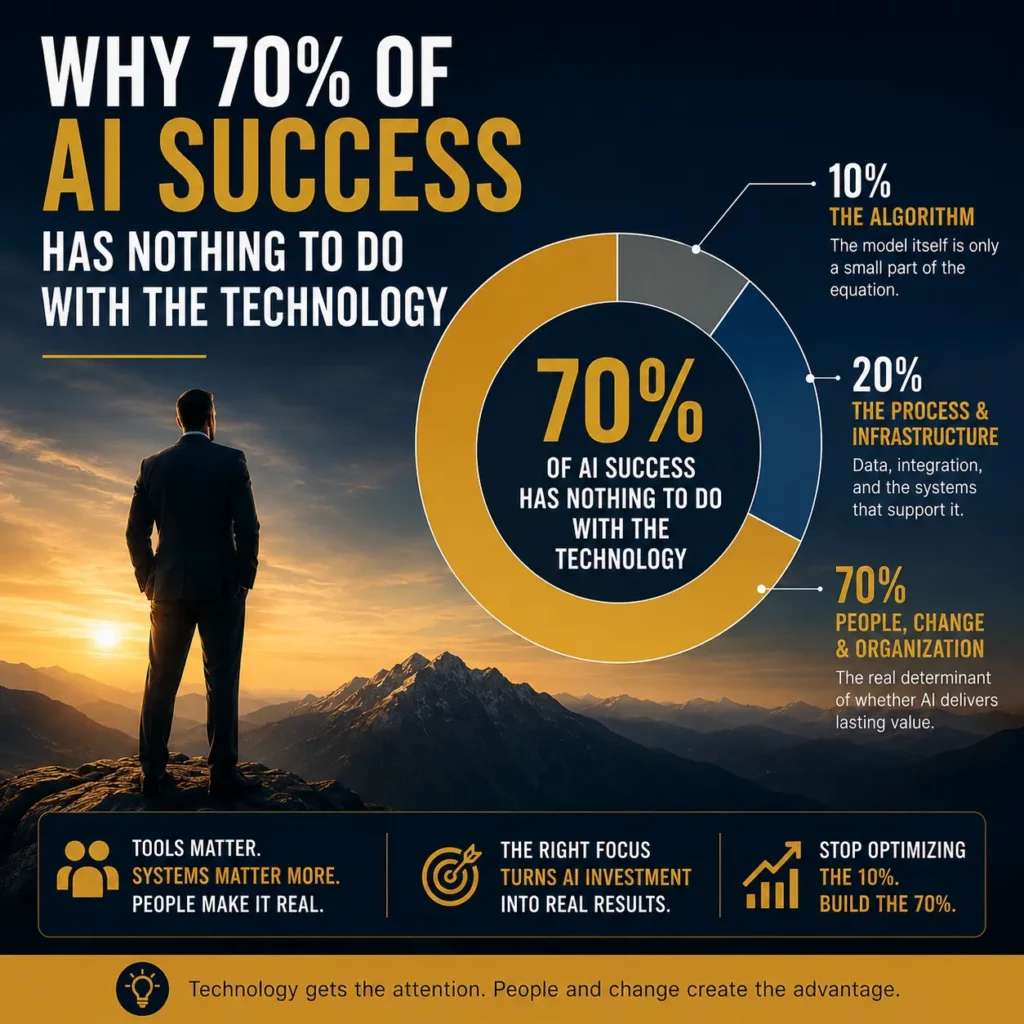
Boston Consulting Group’s analysis of more than 1,000 companies across 59 countries found a clean distribution: 10% of AI success is attributable to the algorithm itself, 20% to the process and technology infrastructure around it, and 70% to people, organizational change, and how the business is set up to absorb what the tool makes possible.
Most companies invert that ratio. They spend the first year arguing about which tool to buy, the second year on implementation and integration, and almost no meaningful time on the organizational layer that actually decides whether any of it works.
That mismatch is why PwC’s 2026 Global CEO Survey found that 56% of CEOs report no significant financial benefit from AI. Not because the technology failed. Because the 70% was never built.
After four years studying what AI is actually doing inside companies, the same pattern keeps showing up in the research and in the conversations: the businesses winning with AI are not the ones using better tools. They are the ones building operating systems around the tools they already have.
The Investment Pattern That Quietly Fails
Most leaders making an AI investment decision today are choosing between platforms. ChatGPT Enterprise or Copilot. Claude for Business or Gemini. The seat licenses are real money. The vendor evaluation takes real time. The decision feels strategic because it feels expensive.
It is also a 10% decision.
The 10% is the tool. The 20% is your data infrastructure, your integration plumbing, your context engineering, and the prompting standards that make the tool produce useful output instead of generic output. That layer matters, and it is usually underbuilt, but it is still not the layer that decides whether AI changes your business.
The 70% is the part almost no one budgets for explicitly. It is the question of whether your team actually changes how they work because of the tool, or simply layers it on top of existing workflows. Whether someone is accountable for the output. Whether “good” has been defined. Whether the people using the tool understand what to trust, what to check, and what to throw away.
You can buy your way into the 10%. You can engineer your way into the 20%. The 70% has to be built deliberately, and most organizations never get to it because they are still optimizing the first two layers.
Why the 70% Is Invisible
The 70% is hard to see for the same reason the work that holds a business together is usually hard to see. It is not on the invoice. It does not show up in the dashboard. It is not something a vendor can sell you.
The 10% has marketing budgets behind it. Every model release is a press cycle. Every benchmark gets a chart. The 20% has consultants and integrators selling implementation services. There is a whole industry built around helping you get the technology layer right.
The 70% has almost no one selling it loudly because it is mostly invisible work. It looks like having a real conversation about which workflows should change. It looks like one person being named accountable for the quality of AI-assisted client deliverables. It looks like a manager telling their team it is okay to admit they do not trust an output. None of that fits on a procurement spreadsheet, so it gets skipped.
When organizations skip it, the tool still gets adopted. The team still uses it. The dashboard still shows usage. But the gains stay incremental, the rework stays high, and the leadership team eventually concludes that AI is not delivering on the promise. The conclusion is wrong. The investment was just aimed at the wrong layer.
What “People and Process” Actually Means
When researchers say 70% of AI success is “people, process, and organizational change,” that phrase does a lot of hiding. It sounds soft. It is not.
The 70% is three concrete things.
The first is measurement. Most organizations are tracking the wrong number. They measure how fast AI produces output. They do not measure what happens after the output exists. Before AI, drafting and reviewing lived in the same workflow column. A consultant wrote the memo and reviewed it; the time for both showed up in the same place. Now drafting takes 20 minutes and reviewing takes 30, but the tracking system logs the 20 and ignores the 30. The gain is real. The loss is invisible. That asymmetry is what makes the dashboard look good while the actual cycle time barely improves.
The second is accountability. When an AI-assisted piece of work reaches a client, who is the named person whose job it was to catch a material error? In most businesses, the honest answer is that there is an assumption, not an assignment. Marketing reviews it. Someone on the team checks. The senior person sees the final version. None of those is a named owner with assigned responsibility. The distinction stays invisible until something goes wrong, usually in the middle of a client conversation no one was prepared for.
The third is capability. A 2025 Upwork study found that 77% of employees using AI say it increased their workload rather than reduced it. The pattern that shows up consistently is that organizations are buying access and assuming capability follows. It does not. Access means the team can open the tool. Capability means they know how to give it the right context, evaluate the output skeptically, and improve it through follow-up instead of accepting the first response. Those are different skills, and most teams have not been trained on either.
Measurement, accountability, capability. That is what “the 70%” actually contains. It is not soft. It is the part of the system that decides whether the tool you bought changes the work you produce.
The Behavioral Layer Most Strategies Miss
There is a fourth element of the 70% that rarely makes it into strategy decks: how your team actually feels about the tool.
BCG’s 2025 AI at Work research surfaced one of the most useful numbers in this whole conversation. 76% of executives believe their employees are enthusiastic about AI. Only 31% of individual contributors actually are. That is a 45-point gap between what leadership thinks the workforce is feeling and what the workforce is actually feeling.
That gap is not a perception issue. It is a strategy issue. If your rollout plan assumes enthusiasm that is not there, the plan is structurally wrong before it starts. People who feel quietly threatened by a tool do not adopt it well. They use it the minimum amount required, hide their concerns, and route around the parts that worry them. The dashboard says adoption is high. The reality says people are using AI without trust.
You cannot get to the 70% without addressing the behavioral layer underneath it. Naming the fear directly, providing real psychological safety, and showing the team how AI changes their work rather than threatens their role is part of the operating system, not separate from it.
What the Top Performers Actually Do Differently
The same BCG research found that at companies pulling ahead on AI, 88% of managers actively use AI in their daily work. At companies falling behind, the figure is 25%. The gap is behavioral, not technological. Both groups have access to the same tools.
The difference is that the leading companies built the 70% deliberately. The managers using AI daily are modeling the behavior. There is a named owner for each AI-touched workflow. The team has been trained on context-building, not just prompting. There is a standard for what good output looks like and a standard for what gets reviewed before it ships. The behavioral layer is being addressed openly instead of avoided.
None of those moves required a better model. They required leadership attention on the layer that actually determines whether the tool produces value.
How to Invest in the 70% Without Stopping the 10%
The first move is not to abandon your tool strategy. It is to add a parallel investment in the layer that decides whether the tool works. Here is the sequence.
Step 1: Audit your investment ratio. Look at what you have spent on AI in the last 12 months across three categories: tools and licenses (the 10%), implementation and integration (the 20%), and explicit organizational change work — training, role redesign, accountability frameworks, manager enablement (the 70%). For most organizations, the third number is close to zero. Naming the ratio is the first step to changing it.
Step 2: Pick one workflow and rebuild it for AI, do not patch it. Most teams take an existing workflow and add AI assistance to a step or two. The 70% move is different: take one significant workflow, redesign it from the ground up assuming AI handles the automatable components and a human handles the judgment calls. The rebuilt workflow looks different than the patched one. The compounding return is also different.
Step 3: Name one accountability owner per workflow. For every AI-touched workflow, identify the specific person whose job it is to own the output. Not “someone on the team.” Not “marketing reviews it.” A named person with assigned responsibility. This single move closes most of the structural gap that lets AI errors reach clients.
Step 4: Train for capability, not access. The training your team needs is not how to log in to the tool. It is how to give the AI useful context, how to evaluate the output skeptically, how to improve it through follow-up instead of accepting the first response, and how to recognize when AI is outside its competence boundary and the human judgment matters more.
Step 5: Address the behavioral layer directly. Have the explicit conversation with your team about what AI changes about their work and what it does not. Name the fear instead of working around it. Show them how their role evolves, not how it disappears. The teams that adopt AI well are the ones that feel safe being honest about what they are using and what they are unsure of.
Step 6: Measure net cycle time, not gross output speed. Change what you track. Stop measuring how fast AI produced the draft. Start measuring total cycle time from work request to delivered, reviewed, client-ready output. That number tells you whether the tool actually changed your business, or whether the speed gain was offset by the rework you stopped counting.
The 10% gets you the tool. The 20% makes the tool work. The 70% is what turns AI from a productivity gadget into a competitive position.
Why This Cannot Wait
Every quarter you spend optimizing the 10% is a quarter the leading companies are spending building the 70%. The compounding works in their favor. Their managers use AI more, so they get better at it. Their accountability frameworks tighten, so quality stays high as adoption grows. Their training improves, so the gap between top performers and average users narrows.
Meanwhile, the companies still debating which model to use are getting the same incremental returns they got last quarter, and concluding that AI is overhyped. The technology is not the issue. The investment is aimed at the layer that produces 10% of the result.
The leaders who shift the ratio now will spend the next twelve months building real operating leverage. The ones who do not will spend the same twelve months wondering why their AI investment is not paying off.
Frequently Asked Questions
What does “the 70%” actually mean in practical terms? It means the parts of AI success that come from people, process, accountability, and organizational change rather than from the tool itself. Specifically: how work is measured, who owns the output, whether the team has been trained for capability and not just access, and how the behavioral layer (trust, fear, role clarity) is being addressed. The 70% is everything that determines whether the tool produces real business value versus surface-level efficiency.
If the 70% is so important, why does no one talk about it? Because no one is selling it. The 10% has a vendor industry behind it. The 20% has consultants and integrators. The 70% is invisible work that does not fit on a procurement line, so it gets skipped in favor of the layers that have budget categories and visible deliverables. That is why companies investing serious money in AI are still getting incremental returns.
How do I justify investing in the 70% when my CFO wants to see ROI on tools? Reframe the conversation around net cycle time and quality, not gross output speed. The 56% of CEOs reporting no financial benefit from AI is your evidence that tool investment alone does not deliver returns. The investment in the 70% is what converts tool spend into measurable business outcomes. Without it, the 10% spend produces dashboard numbers that do not translate to the P&L.
Is the 70% something a department head can build, or does it require CEO-level commitment? A department head can absolutely build the 70% within their function. Naming an accountability owner, redesigning one workflow, addressing the behavioral layer with their team, training for capability instead of access — all of that is possible without enterprise-level buy-in. The full transformation eventually needs executive sponsorship, but the proof of concept that builds the case for it does not.
How long does it actually take to build the 70%? For one workflow, 60 to 90 days to see meaningful results. For a full function, 6 to 9 months. For an organization, 12 to 18 months. The work compounds, so the first workflow is the slowest. The fifth one is fast because the patterns transfer. The leaders who treat this as a multi-quarter capability build rather than a one-time project are the ones who see the returns.
Find Out Where Your 70% Is Underbuilt
Most organizations are running on a more optimistic picture of their AI maturity than the one their business actually reflects. The AI Blind Side Assessment is a 12-question diagnostic that takes under five minutes and tells you where your visibility, accountability, and capability gaps are forming — the three components of the 70% that determine whether your tool investment converts to real returns.
You will see which layer is underbuilt, where your accountability gaps live, and what to address first.